
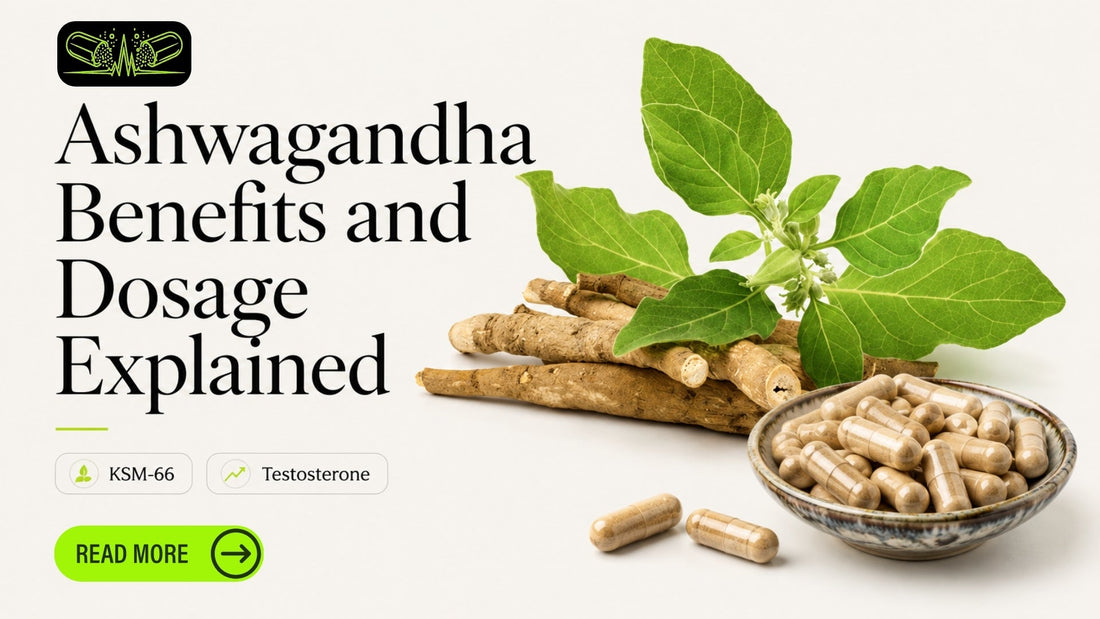
Ashwagandha gets promoted for everything from stress to testosterone. The research is more specific than the marketing.
Ashwagandha may help some adults manage stress and sleep, and human studies suggest it can reduce cortisol. Testosterone support is less certain: some trials in men report increases, but it is not a treatment for low testosterone. Research doses vary by extract, and long-term safety remains unclear, so both the product label and your health history matter.
Speak with a healthcare professional before starting a new supplement if you take medication or have a medical condition.
What Is Ashwagandha?
Ashwagandha (Withania somnifera) is a botanical traditionally used in Ayurvedic medicine. Modern supplements usually contain root extract or a combination of root and leaf extracts containing naturally occurring compounds called withanolides.
The National Center for Complementary and Integrative Health's ashwagandha overview notes that human trials have studied it most commonly for stress, sleep, anxiety, testosterone and several other outcomes, although many studies are small and use different extracts.
That difference between extracts matters. A milligram amount of plain root powder is not automatically equivalent to the same amount of a standardized extract such as KSM-66®.
Ashwagandha Benefits
1. Stress and Cortisol Support
Stress support is one of the better-supported potential ashwagandha benefits.
The NIH Office of Dietary Supplements review of ashwagandha research reports that several randomized trials found reductions in perceived stress and serum or salivary cortisol compared with placebo. Cortisol is one of the hormones involved in the body's stress response.
A more recent systematic review and meta-analysis also found a significant reduction in cortisol across randomized trials, although changes in perceived stress were not equally consistent across every analysis. See the cortisol systematic review on PubMed.
Practical takeaway: Ashwagandha may support the body's response to everyday stress, but “lower cortisol” should not be interpreted as treating anxiety disorders, adrenal problems or other medical conditions.
2. Sleep Support
Ashwagandha may also modestly improve sleep, particularly in people already experiencing sleep problems.
A systematic review and meta-analysis of five randomized trials found a small overall improvement in sleep, with stronger effects among participants with insomnia and in studies lasting at least eight weeks.
This makes the physiology fairly practical: if stress is interfering with winding down, improving the overall stress response may indirectly make sleep easier. However, researchers have not established one single human mechanism that explains all of ashwagandha's effects.
Ashwagandha should still complement, not replace, basic sleep habits such as a regular schedule, adequate sleep opportunity and appropriate medical care for persistent insomnia.
Does Ashwagandha Increase Testosterone?
Possibly in some men, but this is where the evidence needs more careful wording.
NCCIH describes the evidence as limited, noting that some research suggests ashwagandha taken for two to four months may increase testosterone in men. See NCCIH's assessment of the testosterone evidence.
A 2026 systematic review and meta-analysis of randomized controlled trials found an increase in testosterone among men overall, but not women. Read the hormone meta-analysis on PubMed.
One frequently cited eight-week trial involved 57 young men beginning resistance training. Participants receiving 300 mg of ashwagandha root extract twice daily had a greater increase in testosterone than the placebo group. Read the randomized resistance-training study on PubMed.
That does not mean everyone taking ashwagandha will raise testosterone, nor does it make ashwagandha a substitute for evaluation or treatment of clinically low testosterone.
If testosterone is your primary concern, our guide on how long testosterone-support supplements may take to work provides more context, while the testosterone boosters for men collection lets you compare formulas containing different ingredients.
Ashwagandha Dosage: How Much KSM-66 Was Used in Research?
There is no single established medical dose of ashwagandha for everyone.
That is partly because research has used different plant parts, extraction methods and withanolide concentrations. The NIH evidence review specifically notes that this variation makes it difficult to establish one recommended amount.
KSM-66 Dosage in Human Studies
For KSM-66 root extract, 300 mg twice daily, or 600 mg per day, is a commonly studied amount rather than a universal dosage recommendation.
For example:
- A resistance-training trial used 300 mg twice daily for eight weeks. PubMed study.
- KSM-66 research reviewed by NIH has also included a 600 mg daily amount in sleep studies. NIH Office of Dietary Supplements.
Research dose does not mean required dose. Follow the serving instructions for the specific supplement you use and do not increase the amount simply because another study used more.
Check How Much KSM-66 Is Actually in the Product
This matters when reading labels.
For example, Hi Tech Pharmaceuticals Ashwagandha 600 mg sold by Nutritional Supplement Shop provides 600 mg of combined ashwagandha extracts per listed serving, including:
- 125 mg Sensoril®
- 125 mg KSM-66®
- 350 mg AshwaPure®
So the “600 mg” refers to the total ashwagandha formula, not 600 mg of KSM-66 alone.
That is why comparing supplements by the large number on the front of a bottle can be misleading. Check the actual extract, amount and standardization in the Supplement Facts panel.
When Should You Take Ashwagandha?
Research does not establish one universally superior time of day.
The more important factor in most trials was consistent daily use for several weeks, rather than taking the supplement at a particular hour.
If a product makes you drowsy, evening may be more practical. If the label divides the serving, follow its directions rather than combining doses yourself.
Ashwagandha Side Effects
Short-term ashwagandha appears reasonably well tolerated for many adults, but it is not side-effect free.
According to NCCIH's current safety guidance, reported side effects can include:
- stomach upset
- diarrhea
- vomiting
- drowsiness
Rare cases of liver injury have also been linked to ashwagandha supplements. NCCIH says available evidence is insufficient to establish its long-term safety and describes short-term use as being studied for roughly up to three months.
Stop using the product and seek medical advice if you develop a concerning reaction.
Safety Considerations and Who Should Be Careful
NCCIH advises particular caution or avoidance for several groups. Ashwagandha should be avoided during pregnancy and breastfeeding, and professional advice is especially important for people with thyroid or autoimmune disorders, upcoming surgery, or hormone-sensitive prostate cancer. Review the full NCCIH safety guidance.
Potential medication interactions include medicines used for:
- diabetes
- high blood pressure
- thyroid conditions
- seizures
- immune suppression
- sedation
Do not stop or change prescribed medication in order to take ashwagandha.
How to Choose an Ashwagandha Supplement
Keep the decision simple.
Look for a label that tells you which extract you are getting, how much is present and how it is standardized. This lets you compare the product with the extract and amount actually studied rather than relying on marketing language.
This matters because the FDA does not pre-approve dietary supplements for safety and effectiveness before they reach the market. Manufacturers remain responsible for product safety and compliant labeling.
If your primary goal is general ashwagandha supplementation, you can review the label and ingredients of Hi Tech Pharmaceuticals Ashwagandha 600 mg or browse the broader health and wellness supplement collection.
If testosterone support is specifically your goal, compare the ingredient profile rather than assuming ashwagandha alone will solve low testosterone. The shop's Testosterone 21 formula, for example, includes KSM-66 alongside other ingredients, while our guide to buying testosterone and testosterone-support products responsibly explains the important difference between dietary supplements and prescription testosterone.
Conclusion
Ashwagandha has credible human research behind stress, cortisol and sleep support, while evidence for increasing testosterone is promising but more limited and primarily applies to men studied under specific conditions. The practical approach is to choose a clearly labeled extract, follow the product serving instructions, and treat supplements as an addition to, not a replacement for, sleep, nutrition, training or medical care. For product options and ingredient information, visit Nutritional Supplement Shop.
Frequently Asked Questions
Does ashwagandha lower cortisol?
Human trials and systematic reviews suggest ashwagandha can reduce cortisol in some adults experiencing stress. The size of the effect varies between studies and extracts, so it should be viewed as stress support rather than treatment for a cortisol disorder. NIH evidence summary.
Does ashwagandha raise testosterone?
Some randomized studies show higher testosterone after ashwagandha supplementation in men, but NCCIH still considers the evidence limited. It should not be used to self-treat suspected low testosterone. NCCIH assessment.
How much KSM-66 should you take per day?
There is no universally established dose. 600 mg per day, often divided into two 300 mg doses, has been used in several KSM-66 trials, but that is a research protocol rather than a dosage recommendation for every person. See the human trial on PubMed.
What are the most common ashwagandha side effects?
Reported effects include stomach upset, diarrhea, vomiting and drowsiness. Rare liver injuries have also been reported, which is one reason long-term unsupervised use should not automatically be assumed safe. NCCIH safety information.
How long does ashwagandha take to work?
Do not expect an immediate effect based on the clinical evidence. Many stress, sleep and testosterone studies assessed outcomes after roughly six to eight weeks or longer, so benefits seen in research generally developed with consistent use over time. NIH research summary.
Can you take ashwagandha every day?
Most human trials use it daily, but mainly for relatively short periods. NCCIH says there is not enough evidence to determine long-term safety, so daily use for months or years should not simply be assumed safe. NCCIH long-term safety guidance.
Do you need to cycle ashwagandha?
Research has not established a standard “cycling” protocol for ashwagandha. Instead of inventing an on/off schedule, follow the product label and discuss extended use with a healthcare professional if you intend to take it long term.