
You've nailed your fasting window. Water's on the counter. Black coffee is brewing. Then you reach for your usual morning supplement stack - multivitamin, fish oil, maybe a scoop of creatine, and the question hits you: Will any of these break my fast?
You're not overthinking it. This is one of the most common, genuinely confusing questions in the intermittent fasting world. The answer isn't a blanket yes or no. It depends on the supplement, your fasting goal, and your personal health picture. Here's the full, honest breakdown.
What the Research Tells Us?
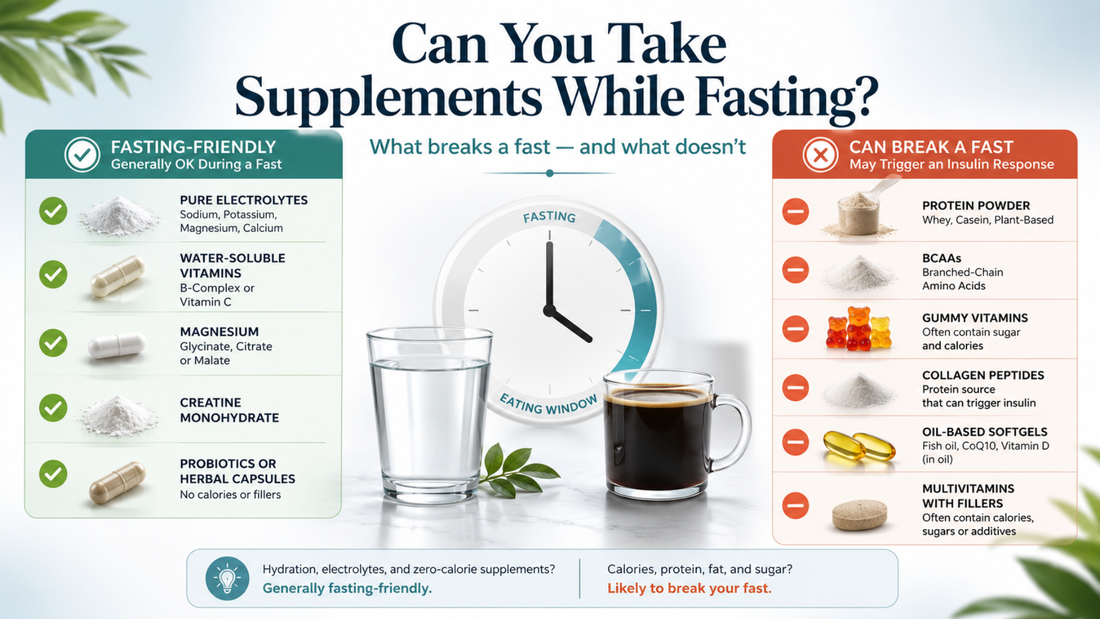
Taking supplements while fasting is possible, but only if you choose correctly. Pure electrolytes, water-soluble vitamins, and certain minerals generally won't disrupt your fast. However, protein powders, BCAAs, gummy vitamins, and oil-based capsules contain calories or amino acids that trigger insulin and break your fasting state. Supplements should be avoided during fasting when they contain sugar, fat, protein, or fillers that stimulate an insulin response or suppress autophagy. Check with a clinician first if you have any medical conditions.
Quick Take
- Not all supplements break a fast - the trigger is calories, protein, or insulin stimulation
- Pure electrolytes, water-soluble vitamins (B-complex, C), magnesium, and creatine are generally fasting-safe
- Gummy vitamins, BCAAs, protein powders, and oil-based capsules will disrupt most fasting goals
- Fat-soluble vitamins (A, D, E, K) are better absorbed with food - save them for your eating window
- If you have diabetes, kidney disease, or take prescription medications, talk to your doctor before timing supplements around a fast
What "Breaking a Fast" Actually Means for Your Supplements?
Not everyone fasting uses the same definition of "broken." Understanding the physiology helps you make smarter calls about your supplement stack.
A fast is generally considered broken when one of two things happens:
- Caloric intake - your body detects energy and stops burning stored fat as its primary fuel
- Insulin spike - certain nutrients trigger your pancreas to release insulin, which signals your body to stop the fat-burning and cellular repair processes associated with fasting
For most people doing intermittent fasting (IF) for weight management or metabolic health, the relevant question is: does this supplement contain meaningful calories or trigger an insulin response? If yes, it disrupts the fast.
For those fasting specifically to activate autophagy, the cellular recycling process where your body clears out damaged proteins and organelles, the threshold is stricter. Even amino acids that appear calorie-free can suppress autophagy by activating mTOR, a cellular growth pathway. When mTOR is active, autophagy shuts down. Leucine, the key amino acid in BCAAs, is a particularly potent mTOR activator.
The practical takeaway: your fasting goal changes what "counts" as breaking it. A supplement safe for a weight-loss-focused fast may still be off-limits for an autophagy-focused fast.
Supplements You Can Take While Fasting
These supplements are generally considered fasting-safe because they contain zero or negligible calories and do not meaningfully spike insulin.
Pure Electrolytes (Sodium, Potassium, Magnesium, Calcium)
Electrolytes are arguably the most fasting-friendly supplement category. When you fast, especially for extended periods or in combination with a low-carb diet, your kidneys excrete more sodium. This triggers a cascade of losses, potassium and magnesium follow. The result: fatigue, headaches, muscle cramps, and brain fog that people often blame on fasting itself.
A clean, zero-sugar electrolyte supplement fixes this without disrupting your fast. The keyword is clean; look for formulas with no added maltodextrin, cane sugar, glucose syrup, or flavored fillers that add hidden calories.
Water-Soluble Vitamins (B-Complex and Vitamin C)
Vitamins B1, B2, B3, B5, B6, B9 (folate), B12, and vitamin C are water-soluble, meaning they dissolve in water and don't require dietary fat for absorption. They contain negligible calories and won't trigger a meaningful insulin response. These are safe to take during a fasting window.
One real-world caveat: some people experience nausea when taking B vitamins on an empty stomach. If that's you, move them to your first meal; absorption will still be solid.
Magnesium (Citrate or Glycinate Form)
Magnesium is involved in over 300 enzymatic reactions in the body and is one of the most commonly depleted minerals during fasting. Magnesium citrate and glycinate are calorie-free, well-tolerated in capsule form, and won't interrupt your fast. Many people find that taking magnesium glycinate before bed, even during a fasting window, improves sleep quality and reduces overnight muscle cramps.
Creatine Monohydrate
Creatine surprises people. It has zero calories, no amino acids in a form that triggers meaningful insulin, and doesn't break ketosis. For the vast majority of fasting goals, creatine monohydrate is considered safe to take during a fasting window.
Creatine works by saturating muscle tissue over a loading phase. Whether you take it fasted or fed has no meaningful impact on how well it works. Consistency of intake matters far more than timing. Want to know how creatine holds up over time? See our Creatine Expiration Guide: Shelf Life & Safety for what to look for in your products.
Capsule-Based Probiotics
Plain capsule or tablet probiotics typically contain no calories and won't break a fast. Some protocols actually recommend fasted probiotic intake on the basis that less stomach acid competition may improve bacterial survival to the gut. Avoid gummy probiotics, liquid kefir shots, and any probiotic that comes with added sugar or fruit juice; those formats add calories.
Herbal Extracts in Capsule Form
Supplements like ashwagandha, berberine, rhodiola, and quercetin, when formulated as plain capsules without added fillers or sweeteners, contain negligible calories and don't disrupt fasting. Berberine is particularly interesting in the fasting context because it may support healthy blood glucose and insulin sensitivity, complementing fasting's metabolic effects. To understand how antioxidant supplements like quercetin compare to coenzyme-based options, see our article on Quercetin Versus CoQ10.
Quick Take: Generally Safe During a Fasting Window
- Pure electrolytes with no added sugar (sodium, potassium, magnesium, calcium)
- Magnesium citrate or glycinate capsules
- Water-soluble vitamins - B-complex and vitamin C
- Creatine monohydrate (unflavored, plain capsule or powder)
- Capsule-form probiotics (no gummies)
- Herbal extracts in plain capsule form (ashwagandha, berberine, rhodiola, quercetin)
Supplements That Break a Fast
These supplements contain calories, amino acids, or filler ingredients that trigger an insulin response, disrupting your fasting state, stopping fat oxidation, or suppressing autophagy.
BCAAs (Branched-Chain Amino Acids)
This is one of the most common mistakes fasting athletes make. BCAAs - leucine, isoleucine, and valine - activate the mTOR pathway even when a product is labeled "calorie-free." For weight-loss fasters, the insulin response may be small. But for anyone fasting to trigger autophagy, BCAAs shut it down. Save your BCAAs for your training or eating window, where they serve their actual purpose: muscle protein synthesis.
Protein Powders
Protein powders - whey, casein, plant-based blends - contain significant calories and generate a robust insulin response. They break any form of fast, full stop. If you're using protein shakes in your eating window and experiencing digestive side effects, we cover the full picture in our article on whether protein shakes cause digestive issues. For a deeper look at whey specifically, including lactose content, see Does Whey Protein Have Lactose?
Gummy Vitamins
Even premium-brand gummy vitamins almost universally contain sugar, pectin, glucose syrup, or fruit juice concentrate. These caloric ingredients spike insulin. Skip all gummy formats during your fasting window and switch to capsule or tablet equivalents for fasting hours.
Collagen Peptides
Collagen powders and liquid collagen supplements contain amino acids and roughly 35-50 calories per serving. They trigger an insulin response and, for autophagy-focused fasters, suppress the cellular cleanup process. Take collagen with your first meal - the protein in food will actually support collagen synthesis better than a fasted dose anyway.
Fat-Soluble Vitamins in Oil-Based Soft Gels (A, D, E, K)
These vitamins are suspended in carrier oils - olive oil, sunflower oil, MCT oil - which provide a small but real amount of fat and calories. There's a double problem here: the oil can break a strict fast and fat-soluble vitamins are poorly absorbed without dietary fat anyway. You're not just risking your fast - you're also wasting the supplement. Take them with food.
Multivitamins With Fillers or Coatings
Many mainstream multivitamins include inactive ingredients like maltodextrin, sugar coatings, or binder agents that contribute small caloric loads. For casual fasting, this may not matter. For strict autophagy or extended-fast protocols, these hidden additives can be enough to disrupt the fasting state.
Quick Take: Avoid During a Fasting Window
- BCAAs and amino acid complex supplements
- Protein powders (whey, casein, plant protein, collagen)
- Gummy vitamins, any brand or variety
- Fat-soluble vitamins in oil-based soft gels (vitamins A, D, E, K)
- Multivitamins with maltodextrin, sugar coatings, or filler agents
- Pre-workout formulas containing carbohydrate matrices, amino acids, or added sugars
Fat-Soluble vs. Water-Soluble Vitamins: Why Timing Changes Everything
This single distinction will make your entire supplement routine more effective, and it has nothing to do with fasting rules.
Water-soluble vitamins (all B vitamins, vitamin C) dissolve in water, don't require food for absorption, and are excreted through urine when your body has more than it needs. They can be taken during a fasting window without meaningfully disrupting your fast or compromising absorption.
Fat-soluble vitamins (A, D, E, K) require dietary fat to be absorbed and stored in fatty tissue. Without fat present at the time of absorption, your body simply can't utilize them properly. Taking a vitamin D soft gel on an empty stomach during a fast is a double loss: you risk disrupting your fast and you absorb a fraction of what you paid for.
The practical move: shift all fat-soluble vitamins to your first meal. Make sure that the meal contains some healthy fat, olive oil, avocado, nuts, and fatty fish. This one timing adjustment can dramatically improve how well your body actually uses these vitamins.
The Best Time to Take Your Supplements When Fasting
Timing your supplements around your eating window is just as important as choosing the right ones. Here's a practical framework:
During Your Fasting Window
- Electrolytes - especially if fasting beyond 16 hours or exercising fasted
- Magnesium glycinate - particularly useful before bed during a fasting window for sleep quality
- Water-soluble vitamins (B-complex, vitamin C) - safe during fasting; move to meals only if they cause stomach upset on an empty stomach
- Creatine monohydrate - take it consistently; timing relative to fasting doesn't affect efficacy
- Herbal capsules (ashwagandha, berberine, etc.) - generally fasting-safe in plain capsule form
At Your First Meal (Breaking Your Fast)
- Vitamins A, D, E, and K - always take with a fat-containing meal
- Fish oil / omega-3 fatty acids - fat-soluble; take with food for proper absorption
- Collagen peptides - take with a protein-containing meal
- Multivitamins - especially those with fillers or oil-based ingredients
- BCAAs - if you use them, pair with training or meals, not fasting windows
- Iron and zinc - these are strong gastric irritants and must be taken with food
Should You Take Pre-Workout Supplements While Fasting?
A lot of people in America who practice intermittent fasting also work out fasted, typically in the morning before breaking their fast. The pre-workout question is real, and the answer is formula-specific.
What's generally fasting-safe in a pre-workout:
- Pure caffeine or caffeine anhydrous (no calories, no insulin spike)
- L-theanine (pairs commonly with caffeine; no caloric impact)
- Plain beta-alanine in capsule form
- Clean adaptogens like rhodiola
What breaks a fast in a pre-workout:
- Carbohydrate matrices, dextrose, or maltodextrin (very common in "pump" formulas)
- BCAA blends or amino acid complexes
- Creatine HCl blended with sugar
- Flavored formulas that list sugar or fruit juice in the ingredients
The purpose of training fasted is typically to maximize fat oxidation. A pre-workout loaded with fast-digesting carbohydrates defeats that purpose entirely. If you want to train fasted effectively, look for a clean, minimalist formula, or simply use black coffee and electrolytes.
For a comprehensive breakdown of how pre-workout supplements actually function in your body, see our guide: What Do Pre-Workout Supplements Do?
If you're specifically interested in high-stimulant formulas - their benefits, risks, and how to use them without causing problems - start with The Truth About High Stim Pre-Workouts: Benefits, Risks, and How to Use Them Safely. And if you're not sure whether your pre-workout is still good, check out our guide: Can a Pre-Workout Expire?
Creatine and Fasting: Does It Actually Break Your Fast?
For most people and most fasting goals, no, creatine does not break a fast.
Creatine monohydrate is one of the most researched sports supplements in existence. It contains zero calories, no amino acids in a form that triggers meaningful insulin secretion, and has not been shown to suppress autophagy or disrupt ketosis at standard doses (3-5g per day).
Creatine works by saturating phosphocreatine stores in your muscle tissue, which fuels high-intensity contractions (particularly during the ATP-PCr energy system). This saturation happens over a loading period, and the timing of any individual dose relative to your fasting window has negligible impact on its effectiveness.
One caveat: not all creatine products are pure. Some blends on the market add dextrose, maltodextrin, fruit flavoring, or proprietary carbohydrate matrices to the formula - often marketed as aiding creatine absorption. These blended products will break a fast. Stick to unflavored creatine monohydrate in a plain capsule or powder form.
Not sure if your creatine product is still effective? Our Creatine Expiration Guide: Shelf Life & Safety will help you know what to look for.
Safety Block: When Supplements During Fasting Are Not Safe
For healthy adults, taking the right supplements during a fasting window is low-risk. But there are real clinical situations where this needs medical supervision.
Talk to your doctor before fasting with supplements if you:
- Have type 1 or type 2 diabetes - fasting significantly changes blood glucose dynamics; supplements like berberine can further lower blood sugar and create hypoglycemia risk, especially when combined with insulin or oral diabetic medications
- Take prescription medications - many drugs must be taken with food for proper absorption or to protect the stomach lining; changing your supplement timing without reviewing your medication schedule can affect drug efficacy or safety
- Have kidney disease - high-dose potassium and magnesium supplementation can be dangerous when kidneys can't efficiently regulate electrolyte levels
- Are you pregnant or breastfeeding? Fasting itself is generally not recommended during pregnancy; supplement timing needs specific clinical guidance
- Have a history of eating disorders - combining fasting protocols with strict supplement routines can reinforce restrictive patterns
- Are under 18 years old - fasting and aggressive supplement protocols are not designed for adolescents
Warning signs to watch for during fasting:
- Dizziness, lightheadedness, or fainting
- Heart palpitations or irregular heartbeat (often signals electrolyte imbalance)
- Severe nausea or vomiting after taking supplements on an empty stomach
- Extreme fatigue or sudden weakness
- Confusion or difficulty concentrating
Special notes on gastric irritants:
Iron supplements and zinc salts are well-documented gastric irritants. When taken on an empty stomach, these minerals frequently cause nausea, stomach cramping, and vomiting. They should always be taken with food - period. Do not attempt to take these during a fasting window regardless of your fasting goals.
If you experience any of the warning signs listed above while fasting, stop the fast, eat a small balanced meal, and consult your doctor before resuming. Your Doctor may recommend adjusting supplement timing, dosing, or your fasting protocol altogether based on your individual health situation.
Quick Take: Safety Priorities
- Iron and zinc must always be taken with food - never fasted
- Berberine and blood sugar-lowering supplements require medical oversight if you're diabetic
- Electrolyte imbalance (not the fast itself) causes most fasting-related symptoms
- Prescription medications should not be re-timed around fasting without your doctor's input
- Heart palpitations during fasting require immediate medical attention
Frequently Asked Questions:
1. Will a multivitamin break my fast?
Most mainstream multivitamins contain filler ingredients, sugar coatings, or oil-based soft gels that add small caloric loads or fat. To protect your fast, take your multivitamin with your first meal rather than during your fasting window. If your multivitamin is a pure, water-soluble tablet or capsule with no added fillers, it may be fasting-safe, but check the inactive ingredients list carefully.
2. Can I take fish oil while fasting?
Fish oil is fat-based and requires dietary fat for proper absorption. Taking it during a fasting window both risks breaking your fast and results in poor bioavailability; you'll absorb very little. Move fish oil to your first meal and pair it with food that contains healthy fat. You'll get far more benefit this way.
3. Does vitamin D break a fast?
Most vitamin D supplements come in an oil-based soft gel format that provides a small amount of fat and calories. For strict fasting, this technically disrupts the fast. Beyond the fast-breaking concern, vitamin D is fat-soluble and requires dietary fat for absorption anyway, making your eating window the correct time to take it. Pair it with a meal that has some fat.
4. Can I take magnesium while fasting?
Yes. Magnesium in capsule form, particularly magnesium glycinate or citrate, contains no calories and does not break a fast. It's one of the most commonly depleted minerals during fasting, and taking it during your fasting window (especially before sleep) can reduce muscle cramps and support sleep quality. Avoid magnesium formulas with flavored powders that may contain added sugar.
5. Do BCAAs break a fast?
Yes, particularly for anyone fasting for autophagy. BCAAs activate the mTOR signaling pathway, which directly suppresses autophagy. Even when products are labeled "zero calorie," the leucine, isoleucine, and valine present still interfere with cellular cleanup processes. For weight-loss-only fasting, the impact may be smaller, but the cleaner approach is to save BCAAs for training or eating windows.
6. Can I take probiotics on an empty stomach while fasting?
Capsule-form probiotics are generally safe during a fasting window. They contain no meaningful calories and won't spike insulin. Some evidence suggests that taking probiotics on an empty stomach may actually improve the survival rate of bacteria through the gastric environment. Avoid probiotic gummies or liquid formats with added sugar or juice, which do contain calories.
7. Is it okay to take ashwagandha while fasting?
Ashwagandha in plain capsule form contains negligible calories and is considered fasting-safe for most people. It's an adaptogen that may help modulate cortisol, which can rise during extended fasting periods, making it a logical choice during a fasting window. However, if you have thyroid conditions, hormonal sensitivities, or take other medications, check with your doctor before adding it.
8. What about protein shakes after breaking a fast - are they a good choice?
Yes, when timed correctly to your eating window, protein shakes can be an efficient way to hit your daily protein goals post-fast. Breaking a fast with a protein shake is fine. Taking one during your fast breaks it. If you've ever noticed digestive issues with protein shakes, including bloating or constipation, our guide on Do Protein Shakes Cause Constipation? and the role of lactose in whey at Does Whey Protein Have Lactose? cover the most common causes.
9. Should I take electrolytes during a 24-hour or extended fast?
Absolutely. After around 16-18 hours of fasting, sodium, potassium, and magnesium levels can drop significantly, causing fatigue, headaches, light-headedness, and muscle cramps, the classic "fasting flu." Pure zero-sugar electrolyte supplements are essential for any fast beyond 16 hours. They won't break your fast and they'll dramatically improve how you feel.
10. What's the smartest supplement approach if I work out while fasting?
Keep your fasting-window supplementation to electrolytes and pure caffeine (if needed). After your workout, break your fast with a protein-containing meal. Use that eating window to take your fat-soluble vitamins, fish oil, collagen, BCAAs, and any other supplements best absorbed with food. Don't try to cram your full supplement stack into a fasted workout window; it will either break your fast or be poorly absorbed, or both.
CONCLUSION
You now know that taking supplements while fasting is less about a yes-or-no rule and more about understanding which supplements work with fasting and which ones work against it. Pure electrolytes, magnesium, water-soluble B vitamins, vitamin C, and creatine monohydrate can stay in your fasting window. Gummy vitamins, BCAAs, protein powders, oil-based fat-soluble vitamins, and collagen belong in your eating window. Start by auditing your current stack label by label, and if you're managing any medical condition or taking prescription medications, your doctor should be part of the conversation before you change anything.