
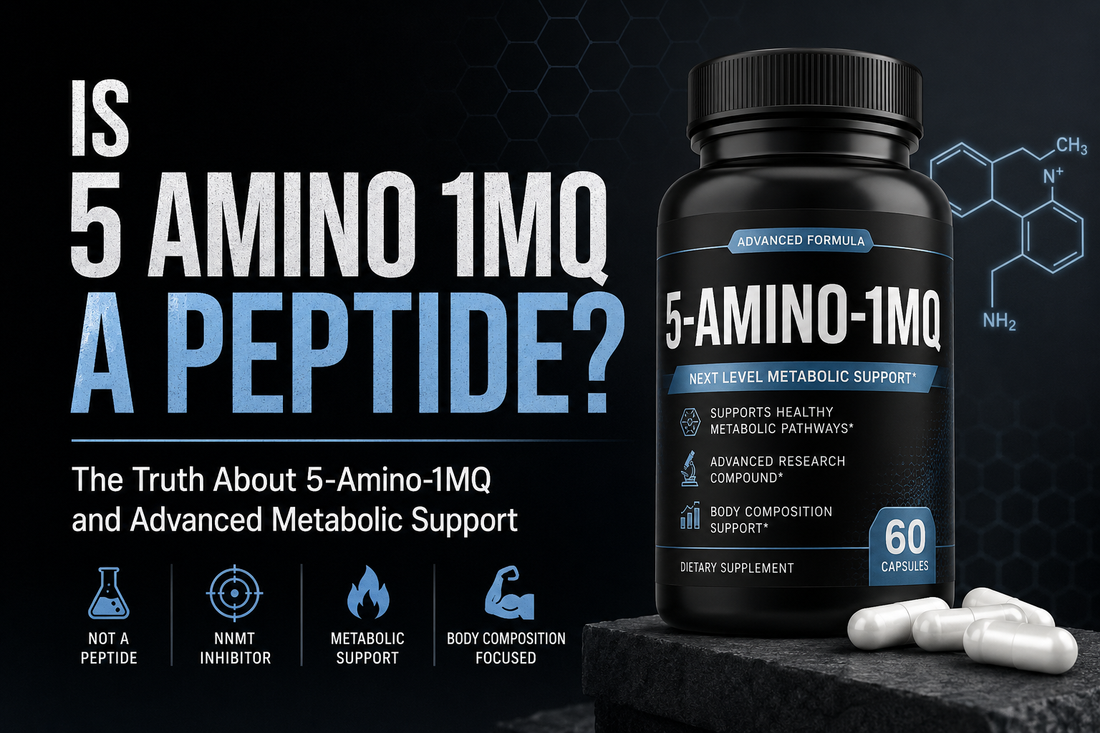
A lot of people search for “5 amino 1mq peptide” because 5-Amino-1MQ is often discussed in the same circles as peptides, metabolic support compounds, and advanced body recomposition formulas. But technically, 5-Amino-1MQ is not a peptide.
A peptide is a short chain of amino acids, typically linked together by peptide bonds. 5-Amino-1MQ, also called 5-amino-1-methylquinolinium, is instead a small-molecule compound commonly discussed for its relationship to NNMT, or nicotinamide N-methyltransferase. (Genome.gov)
That distinction matters. Calling it a “5 amino 1mq peptide” may be common in search engines, forums, and supplement conversations, but the more accurate description is 5-Amino-1MQ small-molecule NNMT inhibitor.
What Is 5-Amino-1MQ?
5-Amino-1MQ is short for 5-amino-1-methylquinolinium. It is most often discussed in relation to NNMT, an enzyme involved in nicotinamide metabolism, cellular energy regulation, and metabolic research. Sigma-Aldrich lists 5-amino-1MQ as a selective NNMT inhibitor and identifies it under the synonym 5-Amino-1-methylquinolinium. (MilliporeSigma)
In simpler terms, researchers are interested in 5-Amino-1MQ because NNMT appears to play a role in how cells manage certain energy-related pathways. This is why 5-Amino-1MQ is commonly found in advanced supplement discussions around metabolism, body composition, and recomposition support.
For users looking for a standalone option, Global Supremacy 5-Amino-1-MQ is one product that focuses specifically on 5-Amino-1MQ. The product page lists 60 capsules per bottle and notes that two capsules provide 50 mg. (Nutritional Supplement Shop)
Why Do People Call It a “5 Amino 1MQ Peptide”?
The phrase “5 amino 1mq peptide” is popular because 5-Amino-1MQ often appears in the same product categories, conversations, and stacks as peptides. There are a few reasons for the confusion.
First, the name includes the word “amino,” which makes it sound peptide-like. Second, many advanced metabolic formulas combine 5-Amino-1MQ with compounds that are peptide-adjacent or peptide-related. Third, some supplement websites categorize 5-Amino-1MQ near peptides because the same customers are often researching both.
For example, Nutra Human Labs Nutra Burn combines 5-amino-1MQ with BAM-15, MOTS-C, and SLU-PP-332. The product page describes MOTS-C as a mitochondrial-derived peptide, which can make the overall formula feel peptide-related even though 5-Amino-1MQ itself is not a peptide. (Nutritional Supplement Shop)
So the search term makes sense from a buyer-intent standpoint. But chemically, 5-Amino-1MQ is not an amino acid chain.
5-Amino-1MQ vs. Peptides: What’s the Difference?
| Category | 5-Amino-1MQ | Peptides |
|---|---|---|
| What it is | Small-molecule compound | Short chain of amino acids |
| Full name | 5-amino-1-methylquinolinium | Varies by peptide |
| Main discussion point | NNMT inhibition and metabolic pathways | Signaling, recovery, hormone, or cellular pathways depending on peptide |
| Why people confuse them | Often sold or discussed near peptides | Peptides are common in advanced performance and body composition circles |
| Accurate term | Small-molecule NNMT inhibitor | Peptide |
The easiest way to remember it: all peptides are built from amino acids, but not every compound with “amino” in the name is a peptide.
What Does Research Say About 5-Amino-1MQ?
The main reason 5-Amino-1MQ gets attention is its connection to NNMT research. In a peer-reviewed Biochemical Pharmacology study, researchers investigated small-molecule NNMT inhibitors, including methylquinolinium analogues, in adipocytes and diet-induced obese mice. The study reported that NNMT inhibitors reduced intracellular 1-MNA, increased intracellular NAD+ and SAM, and suppressed lipogenesis in adipocytes. In diet-induced obese mice, treatment with a potent NNMT inhibitor significantly reduced body weight, white adipose mass, adipocyte size, and plasma total cholesterol without changing total food intake. (UTMB Health Research Expert Profiles)
Another Scientific Reports study examined NNMT inhibition combined with a reduced-calorie diet in diet-induced obese mice. The authors noted that the study used 5-amino-1-methylquinolinium as the NNMT inhibitor and investigated changes in body composition and microbiome patterns. (Nature)
The important SEO-friendly but accuracy-safe takeaway is this: 5-Amino-1MQ is discussed because of preclinical metabolic research, but it should not be treated as a guaranteed fat-loss shortcut or a replacement for diet, training, sleep, and consistency.
How 5-Amino-1MQ Fits Into Metabolic Support Formulas
Because 5-Amino-1MQ is commonly discussed in relation to cellular energy regulation and body composition research, it is often positioned in formulas designed for cutting phases, recomposition periods, and advanced metabolic support.
For a simple 5-Amino-1MQ-focused option, Global Supremacy 5-Amino-1-MQ is the most direct internal product fit.
For users looking for a broader metabolic formula, HP Pharma Metabolic — AOD-9064, 5-Amino-1MQ, L-Carnitine Tartrate combines 5-Amino-1MQ with L-Carnitine L-Tartrate and AOD-9064. The product page lists 75 mg of 5-Amino-1MQ, 500 mg of L-Carnitine L-Tartrate, and 300 mcg of AOD-9064 per one-capsule serving. (Nutritional Supplement Shop)
For experienced users who want a more technical formula, Nutra Human Labs Nutra Burn features 5-amino-1MQ, BAM-15, MOTS-C, and SLU-PP-332. The product page describes it as a non-traditional metabolic performance formula designed to pair with structured nutrition, training, and a disciplined cutting phase. (Nutritional Supplement Shop)
Is 5-Amino-1MQ a Fat Burner?
This depends on what someone means by “fat burner.” Traditional fat burners often rely on stimulants, caffeine, thermogenic ingredients, or appetite-support ingredients. 5-Amino-1MQ is different. It is usually discussed as an advanced metabolic support compound because of its relationship to NNMT research rather than as a basic stimulant-based fat burner.
That is why the phrase “5 amino 1mq peptide” often appears in advanced supplement searches instead of general weight-loss searches. People looking for 5-Amino-1MQ are usually not just searching for energy or appetite support. They are often looking for something more technical that fits into a structured training and nutrition plan.
Still, it is important to be precise: 5-Amino-1MQ should be viewed as a supplement ingredient associated with metabolic support discussions, not as a stand-alone solution for weight loss.
Who Is 5-Amino-1MQ Best Suited For?
5-Amino-1MQ products are typically best suited for experienced supplement users who already have the basics handled: resistance training, cardio, protein intake, sleep, hydration, and a consistent calorie strategy.
It may be especially relevant for people researching:
-
Advanced metabolic support supplements
-
Cutting or recomposition support
-
Non-stimulant body composition formulas
-
NNMT inhibitor discussions
-
Peptide-adjacent supplement stacks
Beginners looking for a simple fat burner may be better served by starting with foundational habits and basic supplements first. Advanced formulas tend to make the most sense when the user already understands training, nutrition, and consistency.
FAQ: 5 Amino 1MQ Peptide
Is 5 Amino 1MQ a peptide?
No. Despite the popular search phrase “5 amino 1mq peptide,” 5-Amino-1MQ is not technically a peptide. It is a small-molecule compound known as 5-amino-1-methylquinolinium.
Why is 5-Amino-1MQ grouped with peptides?
5-Amino-1MQ is often grouped with peptides because it is discussed in advanced body composition and metabolic support circles. Some formulas also combine it with peptide-related compounds, which adds to the confusion.
What does 5-Amino-1MQ do?
5-Amino-1MQ is commonly discussed for its relationship to NNMT, an enzyme involved in nicotinamide metabolism and cellular energy regulation. Most of the strongest published discussion around 5-Amino-1MQ comes from preclinical research.
What is the best 5-Amino-1MQ product?
For a focused product, Global Supremacy 5-Amino-1-MQ is a direct option. For broader formulas, HP Pharma Metabolic and Nutra Human Labs Nutra Burn both include 5-Amino-1MQ as part of more advanced metabolic support profiles.
Is 5-Amino-1MQ stimulant-based?
Not typically. 5-Amino-1MQ is not usually positioned like a traditional stimulant-heavy thermogenic. It is more commonly discussed as an advanced metabolic support ingredient.
Bottom Line: Is 5 Amino 1MQ a Peptide?
5-Amino-1MQ is not a peptide. The phrase “5 amino 1mq peptide” is common because shoppers and researchers often find 5-Amino-1MQ in peptide-adjacent supplement categories, but the compound itself is a small-molecule NNMT inhibitor.
For users researching advanced metabolic support, 5-Amino-1MQ is worth understanding because it is different from basic stimulant fat burners and different from true peptides. Whether you choose a standalone option like Global Supremacy 5-Amino-1-MQ, a three-ingredient metabolic formula like HP Pharma Metabolic, or a more advanced formula like Nutra Human Labs Nutra Burn, the key is to use it as part of a disciplined approach to training, nutrition, and recovery.
Suggested disclaimer for the page: These statements have not been evaluated by the Food and Drug Administration. This product is not intended to diagnose, treat, cure or prevent any disease. FDA guidance notes that dietary supplement structure/function claims require this type of disclaimer and must not claim to diagnose, treat, cure, or prevent disease. (fda.gov)